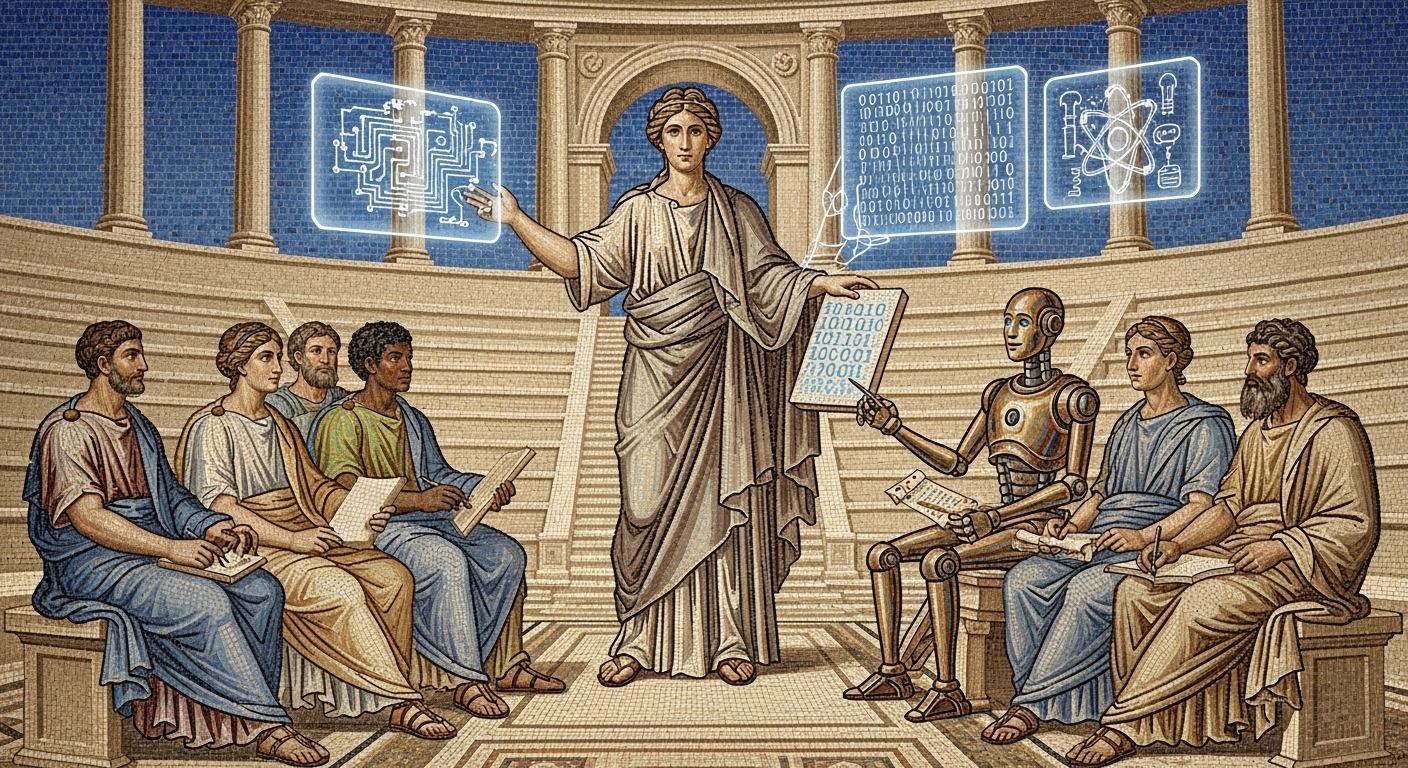
Professor Berthelsen offers an in-person New Orleans AI workshop for organizations, teams, and small groups, drawing on his experience designing and teaching Tulane's Artificial Intelligence Tools course and the AI Mastery Workshop Series.
Every workshop is personalized. Before each session, Professor Berthelsen learns about the participants—their industry, experience level, and what they're hoping to get out of it—so that examples, demonstrations, and hands-on practice are relevant to their actual work.
Workshops are typically either one 3-hour session or two sessions of 2 hours each, for groups of up to about 20 participants. Contact Professor Berthelsen for more information or to discuss a workshop for your team.
What the Workshops Cover
What Is AI and How Does It Work
Most people use AI without understanding what it's actually doing. A recent survey found that only 28% of respondents correctly identified that AI works by predicting what words should come next based on patterns—while 45% believed it looks up answers in a database. This module explains the key principles—training, tokens, how models generate output probabilistically—in a way that's clear and non-technical. Understanding this makes everything else easier.
The AI Tool Landscape
An introduction to the key AI tools and what makes each one different: OpenAI's ChatGPT, Anthropic's Claude, Google's Gemini, and specialized tools like Perplexity, Google AI Studio, and NotebookLM. Knowing which tool to reach for—and when—is a big part of using AI well. See also the regularly updated comparison of AI models and tools on the AI Resources page.
What AI Can Do
AI capabilities go well beyond asking it questions. The workshops cover the full range of what current AI tools can do: understanding and analyzing documents and data, generating text and other content, transforming and reformatting information, retrieving and researching information, facilitating discussion and reasoning through complex problems, and the emerging category of agentic AI—tools like deep research, agentic browsers, and AI coding assistants that can take multi-step actions on your behalf.
What AI Can't Do (Yet)
Understanding AI's limitations is just as important as knowing its capabilities. The workshops cover the real constraints: context windows, bias from training data, hallucinations, training cutoffs, the tendency to tell you what you want to hear, and the practical limits on what you can and can't use AI for in different professional contexts.
Best Practices
The difference between mediocre and genuinely useful AI results usually comes down to how you work with the tools. The workshops cover the practices that matter most: knowing your tools, giving context, assigning roles, asking before tasking, working step by step, using examples, and working with a team of AI tools rather than relying on just one.
Personalization and Context Engineering
The most underused features in AI tools are the ones that let you customize them. This module covers custom instructions, memory settings, and working in projects—techniques that turn a generic AI tool into something that understands your work, your preferences, and your context. This is what separates casual users from power users.
Questions and Demonstrations
Every New Orleans AI workshop includes time for questions and live demonstrations tailored to the group's interests—showing AI applied to the kinds of tasks participants actually do in their work.
Tulane AI Workshops
Professor Berthelsen also runs the AI Mastery Workshop Series at Tulane University—a series of independent workshops on how AI works, what's new, deep research, and mastering specific tools like Gemini, ChatGPT, and Claude.
